
Vincent de Rosa was in the prime of his playing career with nearly twenty years of first horn experience when the major studios put an end to the contract orchestras. He had entered the profession as a teenager and was still in his 30s, as were others of his generation like James Decker, Gale Robinson, and Richard Perissi, when the transition to freelance studio orchestras occurred.62 This generation of horn players was rich in talent, large in numbers, and had accrued experience as young players, in small part due to the weakness of the previous generation. As the number of contract positions declined, the quality of experienced, working horn players rose. What was unusual was that the cast of characters changed so little over the coming years.
It was not until the demise of the studio contract orchestras and the end of the quota laws that the apex of Vincent de Rosa's recording career would be reached. Don Christlieb recalls the impact de Rosa had in the industry:
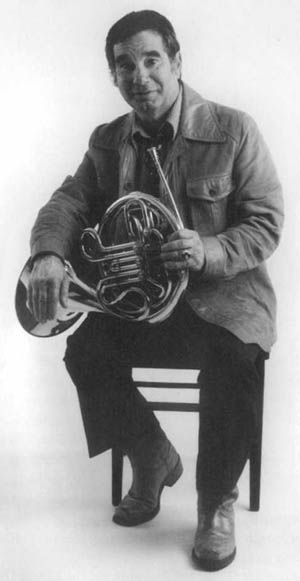
With Vince's superstar reign, even working day and night he could not fulfill all his job offers. His phenomenal solo playing attracted composers to compete with each other, making horn the favorite solo instrument of the film orchestra, and not just for "horn calls" alone. After his studio dates, Vince would rush to the next recording stage for a record date. No one would stand in line behind Vince at the Local 47 payroll desk because his stack of checks would take time to process.63
The preceding quotation touches on a number of important aspects of de Rosa's career. The most obvious was his popularity as a "first-call" horn player in en era of consolidation in the recording industry when even fewer full-time musicians were employed. A broader impact of his career was an increase in the already prominent role of the horn in film music, which his mentor Alfred Brain had begun. This was also due to the fact that the studios often had in-house arrangers and orchestrators who knew well the capabilities of their musicians. Jack Cave gives a specific example of one of those arrangers:
I'd have paid to go to MGM in those early days. Particularly when we got some really good writers in there like Conrad Salinger, the orchestrator, who wrote arrangements. He just had a way of writing for the horn that made it so beautiful (the way he fitted it in to the arrangements). In fact, in backgrounds of songs, he used the horn so nicely, I thought, "Boy, I ought to keep you on salary for myself," because up until then we never had anybody writing beautiful stuff to make the horn sound so good.
Composers often wrote specifically for or requested de Rosa. His impact on Hollywood composers brought about a new standard for studio horn parts.
Unlike Alfred Brain, the major part of de Rosa's career would be spent in the studios. De Rosa's natural proclivity matched the most important playing requirements for recording. Above all, accuracy was crucial, take after take, no matter how many hours or sessions he had played already. Early in his career, as a teenager, de Rosa displayed an amazing accuracy that included notes, intonation, and blend, as recounted by Cave:
I remember [Vince] was on a record date with me. We had a unison up to a high [concert] f '' on a difficult high part in unison for two horns. It was so perfect I couldn't believe it. I had never worked with anybody like this. It sounded like one horn all the way, and we kept doing it over and over and over. I wondered, "When is he going to miss the next one," and he never did. I thought, "We got ourselves a gem here."
James Decker recalls the same accuracy decades later:
His biggest contribution to studio playing was his ability to concentrate beyond any fiddle player or concertmaster, his ability to keep under control even under very painful, stressful conditions. His ability to maintain control, take after take was awesome. One of the pictures we played with John Williams had a long horn solo in the beginning. John was a perfectionist. After the first take, John would listen then come back, make a few improvements in the strings or whatever and call for another take. Again, Vince would play a perfect solo. Again John would come back and ask for another take. Well after all this and hearing Vince do another perfect solo you begin to wonder how he manages such composure and concentration. I think his biggest asset in studio playing was his ability to keep things totally under control. It does get a little nervy after a while.
Along with note accuracy came a consistent, rather heavy articulation. Then there was his beautiful sound that recorded so well and was always picked up "in the mix." The Los Angeles horn style, which evolved largely from de Rosa, is "sound-based" above all, with a full uniform sound from top to bottom. The following recollection by Decker is both amusing and instructive regarding de Rosa's tone:
The biggest asset (Vince's contribution), to me was the sound. I remember going over and playing trios with him when he was a kid. We had to stand outside. His mother wouldn't let us in the house until he had finished his long tones. He measured every tone to make sure the same harmonics were audible and every one of his tones were matching. He was heavily controlled this way.
His ability to match tones extended to his low register as well, being more characteristic of a tuba rather than a trombone. An excellent example of this is the recording he made on Capitol Records of Bach's Partita in B-flat transcribed for and performed with the guitarist, Laurindo Almeida. 64 Conversely, the high notes retained a timbral consistency with the middle register. This characteristic is displayed well in the extended horn solo from the sound track to Rocky III written by Bill Conti. This track was released on an album that included a rare mention of de Rosa's name among the credits. 65 Another characteristic of his sound, was a lack of color or intensity at low volume levels as well as its converse, the ability to play very loud without edge or an appreciable tone color change. This type of sound is particularly useful when sound engineers are constantly changing volume levels.
Another characteristic of de Rosa's horn playing was a consistency of intonation, which was the result of early solfeggio training66 and perfect pitch. One of the advantages of the exclusive use of the Conn 8D throughout the section is in facilitating uniform intonational characteristics. Vincent de Rosa was always equally concerned about both the sound and the intonation. Regarding the adoption of the Conn he states:
It was much better for the intonation of the section because of the overtones of the instruments. Even if you play one note on different instruments, the overtone series is different, so that they don't really come off in spite of being in tune. They don't really meld properly. But if you get four players in unison that are playing the same instrument, it's a much better blend no matter what they are playing, big or small.
Gale Robinson explains how intonation was particularly important because of the overwhelming use of unisons in studio writing.
I think that one of the most critical things with us was pitch, because they wrote so much in unison. In a regular orchestra, you'd have a fellow set up to play first, second or third horn, and he would have good chops, good range and everything, and then you would have [the hornist] down at the fourth. In the symphony he was known for wonderful low notes. You didn't need those things in the studios, so you didn't need a fourth horn player in the studios. You needed two, three or four people that could play first. You're not getting the staggered notes, the thirds and fifths of everything so much. You got them once in a while, but your main lines that you hear in the big stuff that you notice, where all the big money is, is all the unison lines. That is why the studio horn players wanted another first horn with them.
Even in the 1930s, when the writing was more divided, a second horn player who had the ability to play first could be useful, as this recollection by Cave illustrates:
Art [Franz] was in town long before I was. He was the first horn in the Sousa Band for a long time and he went around the world with it. Al Brain introduced us over the phone. Art had called Al Brain while I was sitting there trying to take a lesson from him, and Al said, "Here, you don't need lessons, talk to this guy." Art said, "Come on over and let's play some duets." He had all these opera duets and all kinds of other stuff, so I said, "sure." I went over to his house to play duets and we ended up doing that regularly - maybe three or four times a week. Very shortly after I got in as first horn [at MGM], they were asking me about having a regular second horn and who would you like. I suggested Art Franz, so Art worked at MGM for maybe five or six years or maybe longer. He played a lot of good stuff. I used to turn over part of a number sometimes if I was tired and let him play first for a while. He had an iron lip for high notes and was accurate on the unisons. We got him extra money, which was unusual in the 1930s.
In 1961 the young Zubin Mehta became the director of the Los Angeles Philharmonic. His initial training was in Vienna where the horn sound was smooth and dark. There the F-horn, with a smaller bell, larger lead-pipe, and special Wienerpumpen valves was used exclusively. Many of the tonal characteristics were similar to the Conn. Mehta became enamored with the sound of the Conn coupled with a large mouthpiece and encouraged its use. Since he eventually became the longest serving director of the Los Angeles Philharmonic, this only added to the hegemony of the Conn 8D in Los Angeles. Mehta would later take his preference for the sound of the Conns to the Israel Philharmonic, L'Orchestra del Maggio Musicale Fiorentino, and the New York Philharmonic. With the arrival of Mehta and the disbanding of the studio contract orchestras, the style of working horn players in Los Angeles became ever more unified. Unlike most cities, where the principal orchestra of the city sets the style of horn playing for the freelancers, it was reversed in Los Angeles. If Philharmonic players wanted to take advantage of the lucrative work available in the studios, they were wise to conform to the existing studio style. As Gale Robinson put it, "the LA horn sound was determined by the commercial guys, not by the symphony players."
The possibility of also working in the financially remunerative studios has always made the Los Angeles Philharmonic an attractive job. Since the inception of film tracks, it had been possible to pass from the Philharmonic to the studios or vice-versa. Alfred Brain and James Stagliano were among the first hornists to interchange positions between the Philharmonic and the studios. The next generation of hornists (de Rosa, Decker, Perissi, and Robinson) all passed through the Los Angeles Philharmonic as well. The Philharmonic has been one of the most stable and well-paying symphony orchestras for many years because there existed no full-time opera company to compete for funds. In spite of this, the Philharmonic has not always employed the best musicians in the city, a highly unusual situation anywhere in the world. Although more accurate then than today, the following 1971 statement by Faulkner held true for many years:
Certainly some of the best musicians in Los Angeles are found working in the studio salt mines. Many are also active in teaching and, eventually, in sponsorship of their higher-voltage proteges. Reinforcing this trend is the fact that several of the performers in the Los Angeles Philharmonic are very active studio players. In fact, it was often noted in some of the career histories that one way of coming to the attention of colleagues and contractors was to play in the orchestra as well as in the "casual" concert scene around town. The attraction of the studios also pulled away potential talent from the orchestra, creating, as one can imagine, an interesting situation where the talents of the best musicians in town can be found playing jingles and television commercials rather than Beethoven or Telemann.67
Sinclair Lott, who played principal horn with the Los Angeles Philharmonic for twenty-two years, was a rare exception to the "Philharmonic then studio" route. A native of Los Angeles, he went from first horn at Republic Studios to co-principal horn of the Philharmonic. He also played principal horn in what was a rare collaboration between many of the musicians in the Philharmonic and the studios: the Columbia Symphony Orchestra recordings with Bruno Walter. The Columbia Symphony Orchestra was a unique testament to the level of studio musicians from the late 1950s and 1960s. Under Bruno Walter's baton, the orchestra recorded much of the standard classical repertoire. The Columbia Orchestra also recorded the complete works of Stravinsky, with Stravinsky and Robert Craft68 sharing the conducting duties,69 as well as the complete orchestral works of Schoenberg, Berg, Webern and Varèse conducted by Craft. Special mention goes to James Decker in his role as principal horn on the Stravinsky recordings, including the complete ballet The Fairy's Kiss. It is probably the finest recording of any Los Angeles studio hornist from that era playing symphonic orchestra literature. Decker was easily the most active live performer among the top studio hornists. His live work ran the entire gamut from full symphony to chamber symphony, and chamber music to solo recitals.
With more formalized national auditions, many of the horn players hired by the Philharmonic in the last thirty years have come from other cities. None of these horn players have made the transition from the Philharmonic to the studios. Local musicians who have been hired by the Philharmonic and then left for the studios are rare. One notable exception was Henry Sigismonti, the cousin of Vincent de Rosa. While he grew up in Los Angeles, he began his career as a symphonic player outside Los Angeles, returning to become co-principal horn of the Philharmonic for many years. Like Brain and many others before him, he left the Philharmonic to play in the studios. The difference this time was that he left the orchestra to perform as a freelance musician in the studios. After he left the Philharmonic, he was often found at de Rosa's side playing second horn together with Richard Perissi and Arthur Maebe.
| Previous Chapter | Site Index | Next Chapter |